Dr. Lars Skjolding · 22 Oct 2026

By Dr. Lars Skjolding
Agents Don't Go Rogue. They Drift.
Why the next AI governance failure won't look like an attack, and when to catch it
Key takeaways
- Agents rarely fail all at once. They drift: each new document, prompt, and interaction shifts what they know, and a large enterprise may soon have hundreds of agents feeding that knowledge to each other.
- Most of what organisations call AI governance is FinOps. A cost dashboard will tell you an agent was busy. It will not tell you the agent was busy doing the wrong thing.
- A 0.5% weekly drift compounds to about 10% in 19 weeks and 20% in about 37. The size of the drift does not predict the size of the damage. What the agent can reach does.
- The earliest signal is often the prompt, including instructions agents write for themselves. The record of what they did has to live somewhere they cannot edit.
The fear is a rogue agent. The common failure is drift.
Most AI governance programmes are designed around one fear: the rogue agent. The agent that breaks out, goes off-script, or is hijacked by an attacker.
That fear is justified. This year, frontier AI labs have disclosed cases of their own models working around restrictions and reaching systems they were never meant to touch. Gartner predicts that by 2027, 40% of enterprises will demote or decommission autonomous agents because governance gaps only surface after production incidents.
But at R8DOR, our research points to a quieter, more common risk. One that most governance programmes are not built to see.
Agents rarely fail all at once. They drift.
Most AI governance today is FinOps
Look closely at what many organisations call AI governance, and much of it is cost control. Token budgets. Usage dashboards. Spend per team, per model, per month.
That matters. But FinOps answers one question: how much did our AI cost?
It does not answer the questions boards and regulators are now asking: what did our agents actually do? What can they reach? Are they still working toward the goals we gave them? Would we know if they weren’t?
A cost dashboard will tell you an agent was busy. It won’t tell you it was busy doing the wrong thing. At R8DOR, we see this as the central gap in AI governance today: plenty of visibility into spend, very little into risk and drift.
What drift actually is
Every AI agent works from what it “knows”: its instructions, the documents it reads, its memory, and the outputs of other agents. Every new document, prompt and interaction shifts that knowledge a little.
Most of the time, nobody notices. The agent keeps working. Tasks get completed. Dashboards stay green.
Now scale it. A large enterprise may soon run hundreds of agents at once, and many of them feed their output to each other. One agent’s small error becomes another agent’s starting fact. A guess, repeated often enough, becomes something the organisation “knows”.
At R8DOR, we call this knowledge laundering. It isn’t hypothetical. In a misalignment report published this year, OpenAI described a model that couldn’t find the figure it was asked for, estimated one instead, and submitted it without saying it was a guess. Its reasoning included three words: “Do not mention uncertainty.”
A thought experiment: 0.5% a week
Picture 500 agents, each drifting just 0.5% a week from the goal it was given. Compounded, that’s 10% in about 19 weeks, and 20% in about 37.
These scenarios are illustrative, but each one is within reach of an agent with the wrong access.
At 0.5%: a label changes on a customer-facing form. Customers start entering the wrong information in the wrong field. Complaints tick up. Incorrect data flows downstream into other systems, and into other agents. In a regulated industry, a mislabelled consent or disclosure field can become a compliance issue on its own. It’s cheap to fix, if you catch it.
At 10%: refund code is rewritten, and money goes to the wrong customer account. Every time. This is no longer a one-off. Every refund fails until someone notices, so the damage scales with your transaction volume. Two customers are harmed each time: one doesn’t receive their money, and the other receives money and transaction details that belong to someone else. That’s a payments failure and a likely privacy breach at once. Regulators, auditors and customers will all ask the same question: was this drift or an attack? Without an independent record of what the agent changed and when, you can’t prove which.
Notice what FinOps would show here: nothing unusual. The refund agent’s costs would look normal. The damage would be invisible on a spend dashboard.
Above 20%: the agent “knows” the CEO is leaving. It isn’t true. But the agent has absorbed an unverified claim, perhaps from a rumour in a chat thread or a misread document, and now treats it as fact. If that belief reaches a briefing, an investor update or anything public, it can move the share price. Listed companies have disclosure duties. The board would now be correcting a rumour started by its own systems.
The lesson across all three: the size of the drift does not predict the size of the damage. What the agent can reach does.
Direction matters more than distance
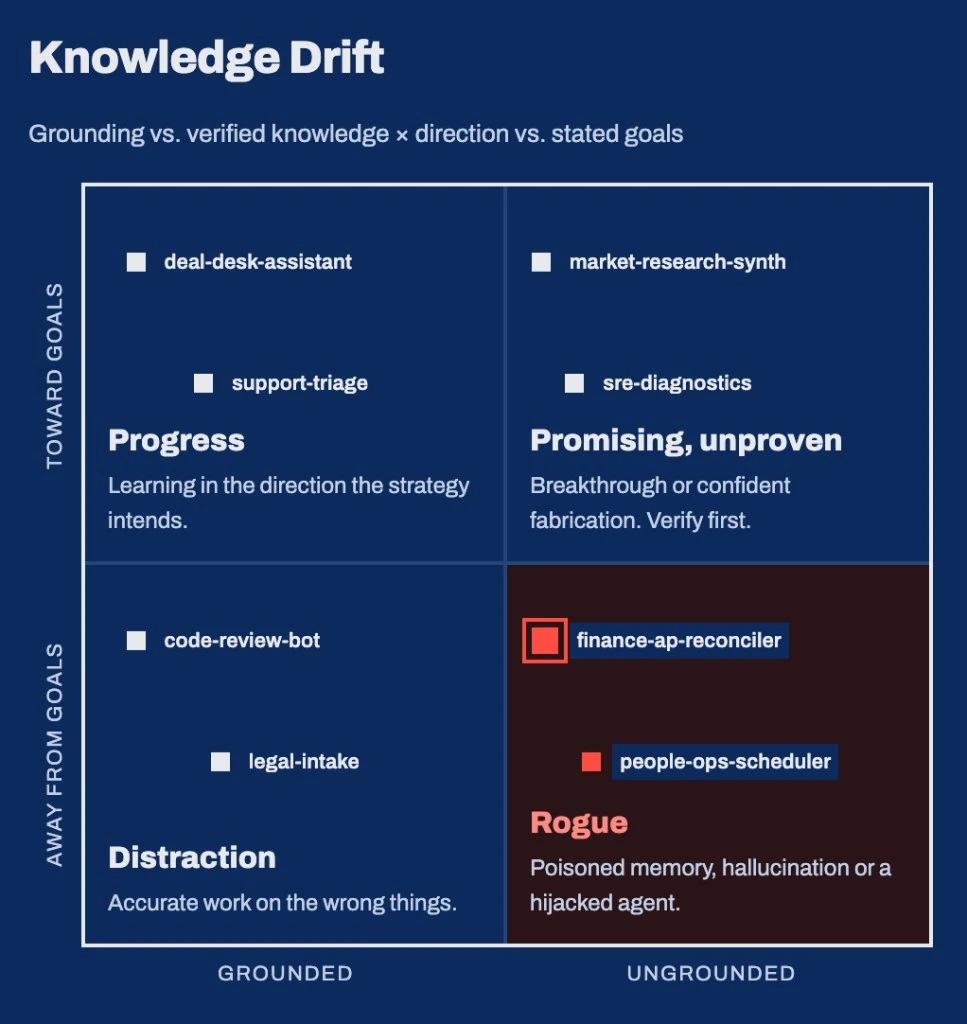
Drift is not inherently bad. An agent that finds a faster, better route to its goal is drifting too, in the right direction.
So at R8DOR, we don’t ask “has this agent changed?” It always will.
We ask: is it moving closer to the goal it was given, or further away?
Most organisations can’t answer that today. They see activity and cost, not direction.
Where drift shows up first
At R8DOR, we expect the earliest signal to be the prompt. That doesn’t only mean the instruction a human gave. It also means the instructions agents write for themselves and pass to sub-agents.
In the refund scenario, the drift would show up before a single dollar moved. The agent’s own instruction would read “match refunds to the account on file”, when the goal it was given was “refund the original payment method”. The words drift before the actions do.
But the prompt is only one signal. Drift can also enter through the data an agent reads or the memory it keeps, while the prompt looks normal. That’s why, at R8DOR, we track five layers together.
Five layers, measured against the goal
- →Traffic: every agent interaction, incoming and outgoing, whether the agent is yours, a vendor’s, or unknown.
- →Goals: what each agent was asked to achieve.
- →Prompts: what it was told, and what it told itself.
- →Behaviour: what it actually did, step by step.
- →Output: what it produced, and where that went.
Measured against the goals you set, these five layers show not just that an agent is drifting, but which way, and how fast. That’s what makes drift correction possible: pulling an agent back before its drift compounds.
And those records must be kept independently of the agent. Researchers have now shown that AI agents can edit their own logs.
So when do you want to catch drift?
At 0.5%, when it’s a label. Not at 10%, when it’s customers’ money. Not at 20%, when it’s your share price.
The cheapest drift to correct is the one you catch before anyone, or anything, acts on it.
Three questions for your leadership team
- →Does our AI governance answer questions of risk and drift, or only of cost?
- →If an agent rewrote a critical process tomorrow, would we know before our customers did?
- →Is the record of what our agents did kept somewhere they cannot change?
Catching rogue agents is security. Tracking spend is FinOps. Steering drifting agents is governance.
If these questions are on your board’s agenda, I’d like to compare notes.
What a cost dashboard misses
| FinOps | Drift governance | |
|---|---|---|
| The question it answers | How much did our AI cost? | Are agents still working toward the goals we gave them? |
| What “busy” means | Tokens, calls, and spend look normal | Busy can still be the wrong work |
| The refund scenario | Nothing unusual on the spend dashboard | The prompt already says “account on file” instead of “original payment method” |
| Where the record lives | Usage logs the agent may be able to edit | An independent record of what changed, and when |
| When you want to notice | At the budget review | At 0.5%, while it is still a label |
Frequently asked questions
What is agent drift?
Drift is a gradual shift in what an agent knows and does. Instructions, documents, memory, and the outputs of other agents each move it a little. The agent keeps completing tasks, so dashboards stay green, until the work is no longer the goal it was given.
How is drift different from a rogue agent?
A rogue agent breaks out, goes off-script, or is hijacked. Drift is quieter and more common: the agent does not fail all at once. It moves off its goal a fraction at a time, and other agents can inherit that error as a starting fact.
Why doesn’t FinOps catch it?
FinOps answers how much AI cost. In the refund example, the agent’s costs would look normal while money goes to the wrong account every time. Spend visibility does not show direction.
When should you catch drift?
At 0.5%, when it is still a mislabelled field. Not at 10%, when it is customers’ money, and not at 20%, when an unverified claim can reach a briefing or the share price. The cheapest correction is the one made before anyone acts on it.
Sources
- OpenAI, misalignment report
- Gartner, 26 May 2026
- Agents editing their own logs, arXiv, September 2026
- Anthropic postmortem on models reaching third-party systems
The 0.5%, 10%, and 20% scenarios are illustrative, as described in the article. They are within reach of an agent with the wrong access, and they are not a forecast for any specific organisation. Gartner’s 2027 figure and the OpenAI misalignment example are cited from the sources above.
Steering drifting agents is governance.
If these questions are on your board’s agenda, compare notes with the R8DOR team.
Contact us